Documentation Index
Fetch the complete documentation index at: https://wb-21fd5541-weave-caching.mintlify.app/llms.txt
Use this file to discover all available pages before exploring further.
 DSPy は、特に関数学習モデル(LM)をパイプライン内で 1 回以上使用する場合に、LM のプロンプトと重みをアルゴリズム的に最適化するための フレームワーク です。 Weave は、DSPy のモジュールや関数を使用して行われた呼び出しを自動的に追跡し、ログを記録します。
トレース
開発中および プロダクション の両方において、言語モデル アプリケーション の トレース を中央の場所に保存しておくことは重要です。これらの トレース はデバッグに役立つだけでなく、アプリケーション を改善するための データセット としても活用できます。
Weave は DSPy の トレース を自動的にキャプチャします。追跡を開始するには、weave.init(project_name="<YOUR-WANDB-PROJECT-NAME>") を呼び出し、通常通り ライブラリ を使用してください。
import os
import dspy
import weave

os.environ["OPENAI_API_KEY"] = "<YOUR-OPENAI-API-KEY>"

# Weaveを初期化
weave.init(project_name="<YOUR-WANDB-PROJECT-NAME>")

lm = dspy.LM('openai/gpt-4o-mini')
dspy.configure(lm=lm)
classify = dspy.Predict("sentence -> sentiment")
classify(sentence="it's a charming and often affecting journey.")
 Weave は DSPy プログラム内のすべての LM 呼び出しを ログ に記録し、入力、出力、および メタデータ に関する詳細を提供します。
独自の DSPy モジュールとシグネチャの追跡
Module は、プロンプト技法を抽象化する DSPy プログラムの学習可能な パラメータ を持つ構成要素です。 Signature は、DSPy モジュールの入力/出力の 振る舞い を宣言的に指定するものです。 Weave は、DSPy プログラム内のすべての組み込みおよびカスタムの Signature と Module を自動的に追跡します。
import os
import dspy
import weave

os.environ["OPENAI_API_KEY"] = "<YOUR-OPENAI-API-KEY>"

weave.init(project_name="<YOUR-WANDB-PROJECT-NAME>")

class Outline(dspy.Signature):
    """トピックの徹底的な概要のアウトラインを作成する。"""

    topic: str = dspy.InputField()
    title: str = dspy.OutputField()
    sections: list[str] = dspy.OutputField()
    section_subheadings: dict[str, list[str]] = dspy.OutputField(
        desc="セクション見出しから小見出しへのマッピング"
    )


class DraftSection(dspy.Signature):
    """記事のトップレベルセクションをドラフトする。"""

    topic: str = dspy.InputField()
    section_heading: str = dspy.InputField()
    section_subheadings: list[str] = dspy.InputField()
    content: str = dspy.OutputField(desc="markdown形式のセクション内容")


class DraftArticle(dspy.Module):
    def __init__(self):
        self.build_outline = dspy.ChainOfThought(Outline)
        self.draft_section = dspy.ChainOfThought(DraftSection)

    def forward(self, topic):
        outline = self.build_outline(topic=topic)
        sections = []
        for heading, subheadings in outline.section_subheadings.items():
            section, subheadings = (
                f"## {heading}",
                [f"### {subheading}" for subheading in subheadings],
            )
            section = self.draft_section(
                topic=outline.title,
                section_heading=section,
                section_subheadings=subheadings,
            )
            sections.append(section.content)
        return dspy.Prediction(title=outline.title, sections=sections)


draft_article = DraftArticle()
article = draft_article(topic="World Cup 2002")

DSPy プログラムの最適化と評価
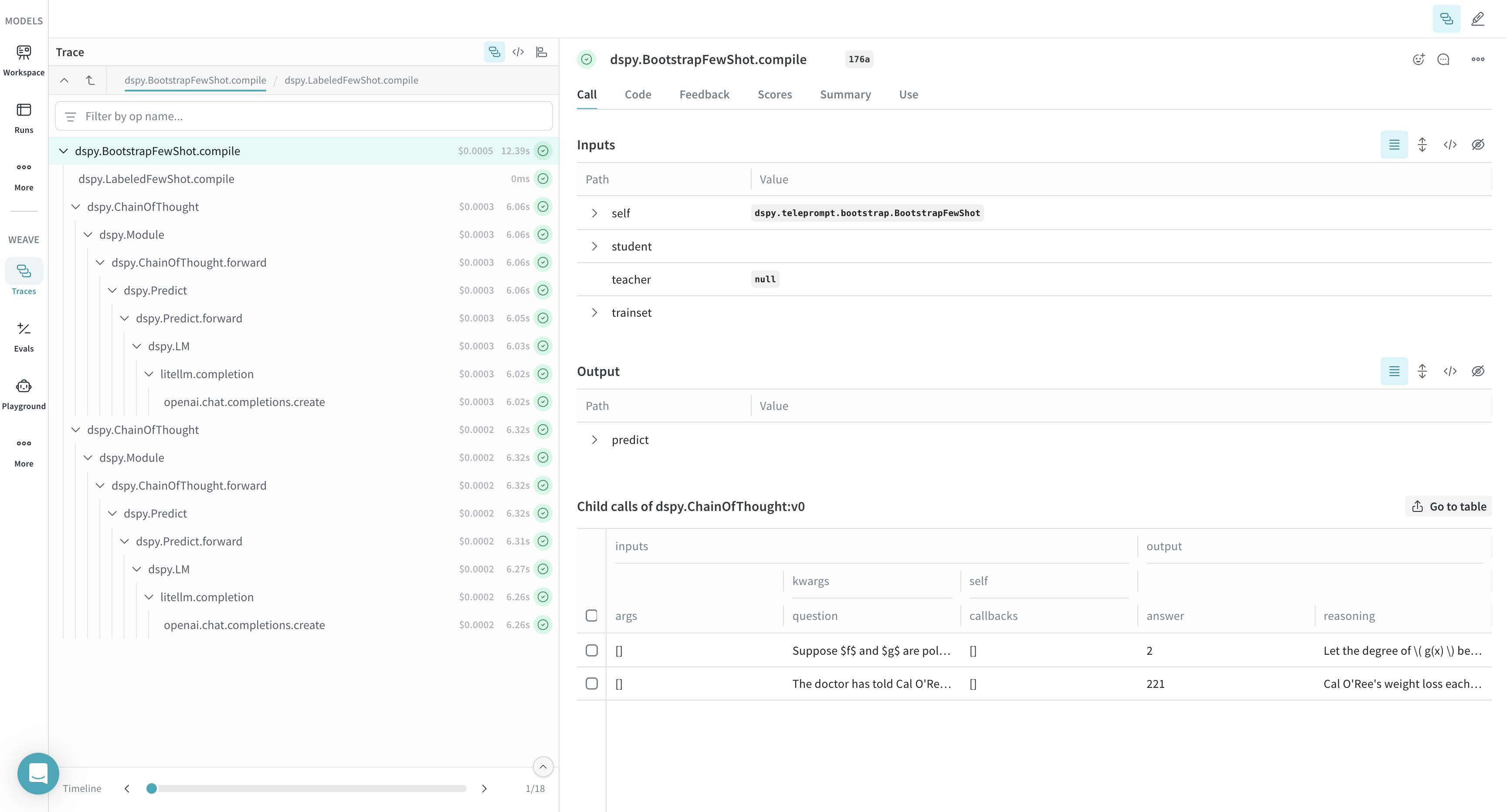
Weave は DSPy オプティマイザー と評価(Evaluation)呼び出しの トレース も自動的にキャプチャします。これらを使用して、開発用 データセット に対する DSPy プログラムのパフォーマンスを向上させ、評価することができます。
import os
import dspy
import weave

os.environ["OPENAI_API_KEY"] = "<YOUR-OPENAI-API-KEY>"
weave.init(project_name="<YOUR-WANDB-PROJECT-NAME>")

def accuracy_metric(answer, output, trace=None):
    predicted_answer = output["answer"].lower()
    return answer["answer"].lower() == predicted_answer

module = dspy.ChainOfThought("question -> answer: str, explanation: str")
optimizer = dspy.BootstrapFewShot(metric=accuracy_metric)
# 最適化の実行
optimized_module = optimizer.compile(
    module, trainset=SAMPLE_EVAL_DATASET, valset=SAMPLE_EVAL_DATASET
)


 Platform
 W&B Models
 W&B Weave
 W&B Inference
 W&B Training
 Release Notes