Documentation Index
Fetch the complete documentation index at: https://wb-21fd5541-weave-caching.mintlify.app/llms.txt
Use this file to discover all available pages before exploring further.
 Weave は、 MistralAI Python library を介して行われる LLM コールを自動的に追跡し、ログを記録します。
新しい Mistral v1.0 SDK をサポートしています。移行ガイドについては こちら をご確認ください。
トレース
開発中および プロダクション の両方において、 LLM アプリケーション の トレース を中央データベースに保存することは重要です。これらの トレース はデバッグに使用されるだけでなく、 アプリケーション を改善するための データセット としても役立ちます。
Weave は mistralai の トレース を自動的にキャプチャします。ライブラリを通常通り使用し、まず weave.init() を呼び出すだけで開始できます。
import weave
weave.init("cheese_recommender")

# その後、通常通り mistralai ライブラリを使用します
import os
from mistralai import Mistral

api_key = os.environ["MISTRAL_API_KEY"]
model = "mistral-large-latest"

client = Mistral(api_key=api_key)

messages = [
    {
        "role": "user",
        "content": "What is the best French cheese?",
    },
]

chat_response = client.chat.complete(
    model=model,
    messages=messages,
)

独自の op でラップする
Weave の op は、 実験 中の コード を自動的に バージョン管理 することで 結果 の 再現性 を高め、入力と出力をキャプチャします。 @weave.op() デコレータを付けた関数を作成し、その中で mistralai.client.MistralClient.chat() を呼び出すだけで、 Weave が自動的に入力と出力を追跡します。チーズレコメンダーでこれをどのように行うか見てみましょう。
@weave.op()
def cheese_recommender(region:str, model:str) -> str:
    "指定された地域の最高のチーズを推薦する"

    messages = [
        {
            "role": "user",
            "content": f"What is the best cheese in {region}?",
        },
    ]

    chat_response = client.chat.complete(
        model=model,
        messages=messages,
    )
    return chat_response.choices[0].message.content

cheese_recommender(region="France", model="mistral-large-latest")
cheese_recommender(region="Spain", model="mistral-large-latest")
cheese_recommender(region="Netherlands", model="mistral-large-latest")

より簡単な実験のために Model を作成する
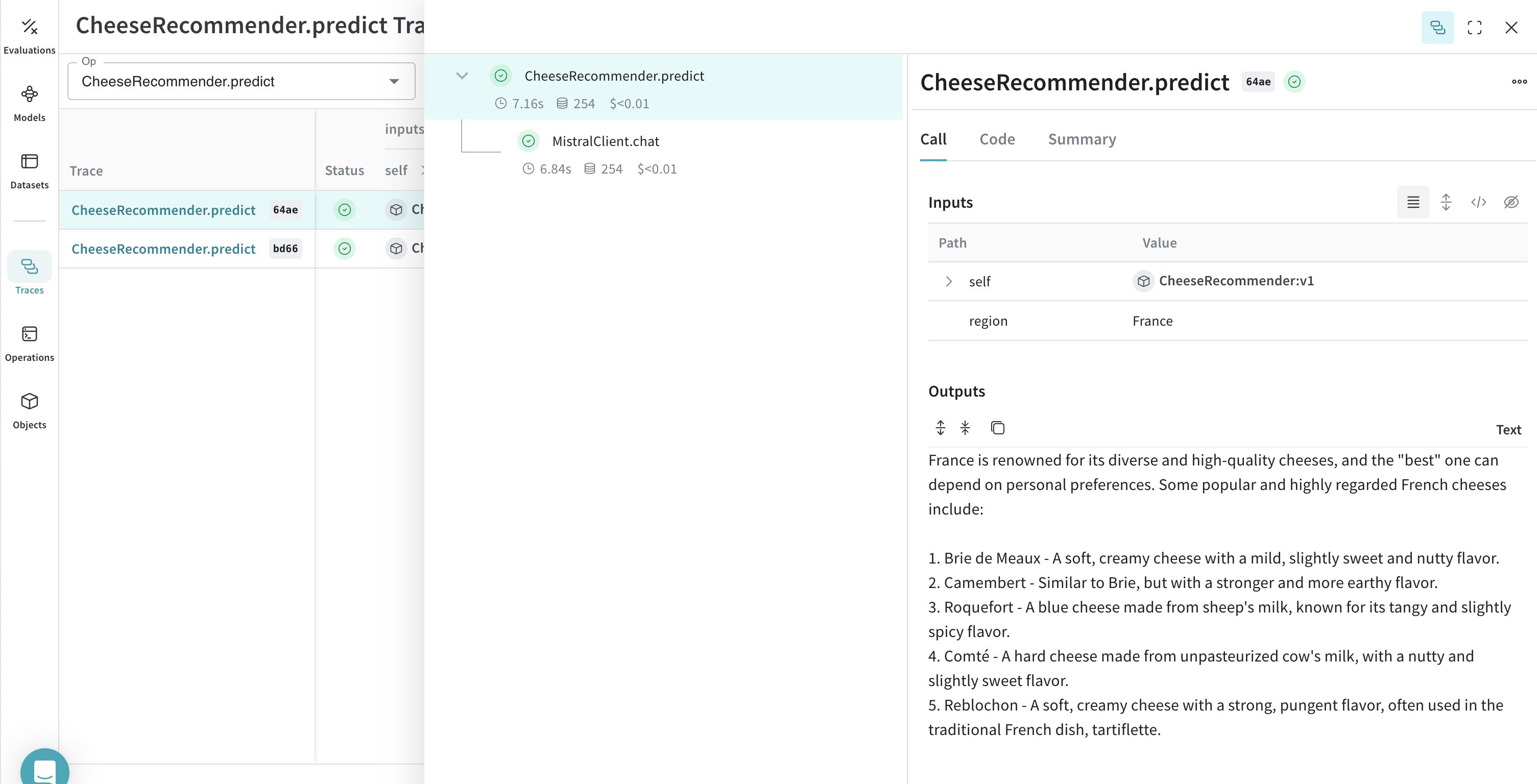
多くの可動パーツがある場合、 実験 を整理するのは困難です。 Model クラスを使用すると、システムプロンプトや使用している モデル など、 アプリケーション の 実験 詳細をキャプチャして整理できます。これにより、 アプリケーション の異なる反復の整理と比較が容易になります。
コード の バージョン管理 や入出力のキャプチャに加えて、 Model は アプリケーション の 振る舞い を制御する構造化された パラメータ をキャプチャするため、どの パラメータ が最適であったかを簡単に見つけることができます。また、 Weave の Models は serve や Evaluation と併用することもできます。
以下の例では、 model や country を使って 実験 できます。これらを変更するたびに、 CheeseRecommender の新しい バージョン が作成されます。
import weave
from mistralai import Mistral

weave.init("mistralai_project")

class CheeseRecommender(weave.Model): # `weave.Model` に変更
    model: str
    temperature: float

    @weave.op()
    def predict(self, region:str) -> str: # `predict` に変更
        "指定された地域の最高のチーズを推薦する"

        client = Mistral(api_key=api_key)

        messages = [
            {
                "role": "user",
                "content": f"What is the best cheese in {region}?",
            },
        ]

        chat_response = client.chat.complete(
            model=model,
            messages=messages,
            temperature=self.temperature
        )
        return chat_response.choices[0].message.content

cheese_model = CheeseRecommender(
    model="mistral-medium-latest",
    temperature=0.0
    )
result = cheese_model.predict(region="France")
print(result)


 Platform
 W&B Models
 W&B Weave
 W&B Inference
 W&B Training
 Release Notes